The move is largely symbolic but carries significant weight, granting the Palestinians enhanced diplomatic standing and the potential for treaty-making. Portugal also confirmed that it will recognise a Palestinian state today, either before or during the United Nations General Assembly. Other countries edging closer to recognition include San Marino, Andorra, Belgium, Malta, Luxembourg, and New Zealand, which are expected to act immediately before or at the UN special conference on a two-state solution scheduled for Monday in New York. French President Emmanuel Macron is expected to lead a press conference announcing France’s formal recognition of the State of Palestine, further intensifying the momentum behind the global campaign. Spain, Norway, and Ireland had already recognised Palestine last year.
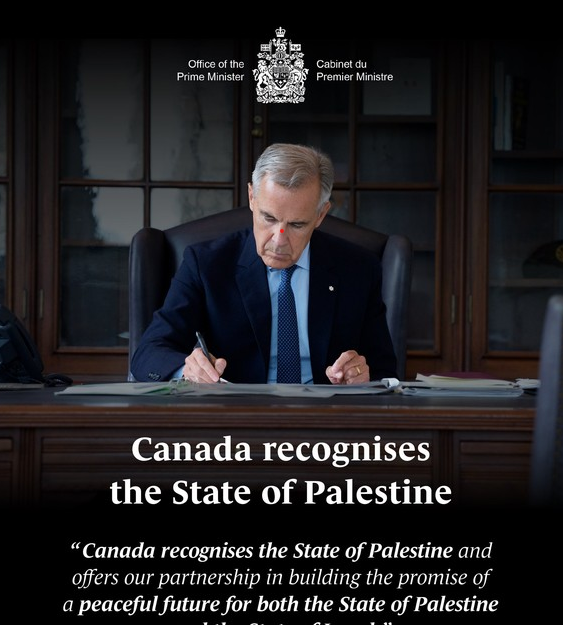
Canada also joined the growing list of nations recognising Palestinian statehood. Prime Minister Carney issued a statement affirming the decision, underscoring the historical commitment of Canadian governments since 1947 to a two-state solution as the foundation for lasting peace in the Middle East. According to Carney, this vision has long centred on the establishment of a sovereign, democratic, and viable Palestinian state living side by side with Israel in peace and security.

The Prime Minister lamented that this possibility has been steadily undermined over time by multiple factors. These include the persistent threat of Hamas terrorism against Israel, most horrifically demonstrated in the October 7, 2023, attack; the organisation’s entrenched rejection of Israel’s right to exist; and its continued use of violence to thwart any path to a two-state solution. He also cited Israel’s intensified settlement expansion across the West Bank and East Jerusalem, the alarming rise in settler violence, and legislative actions such as the Knesset vote endorsing the annexation of the West Bank.
Carney strongly condemned the humanitarian catastrophe in Gaza, holding Hamas responsible for terrorising Israel and oppressing Gazans while also criticising the Israeli government for policies that have resulted in tens of thousands of civilian deaths, the displacement of more than a million people, and a preventable famine. He accused the current Israeli leadership of systematically working to eliminate any prospect of Palestinian statehood, declaring openly that there will be no Palestinian state.

It is within this context that Canada has formally recognised the State of Palestine, aligning its decision with a broader international effort to salvage the two-state solution. Carney stressed that the recognition is neither a reward for terrorism nor a compromise of Canada’s unwavering support for Israel and its security. Instead, it is an affirmation of self-determination and human rights as enshrined in the United Nations Charter.
The statement highlighted that recognition strengthens those within the Palestinian Authority who seek peaceful coexistence and the dismantling of Hamas. Canada noted that the Palestinian Authority has pledged critical reforms, including the organisation of general elections in 2026 in which Hamas will play no role, alongside commitments to demilitarise and improve governance. Ottawa pledged to support these reforms with international partners, encouraging democratic governance, credible security arrangements, and the sustained delivery of humanitarian assistance across Gaza.
Carney concluded by affirming that Canada’s recognition of Palestine is a principled stand, consistent with decades of policy and aimed at fostering a future where Israelis and Palestinians can finally achieve peace through the realisation of two states.